
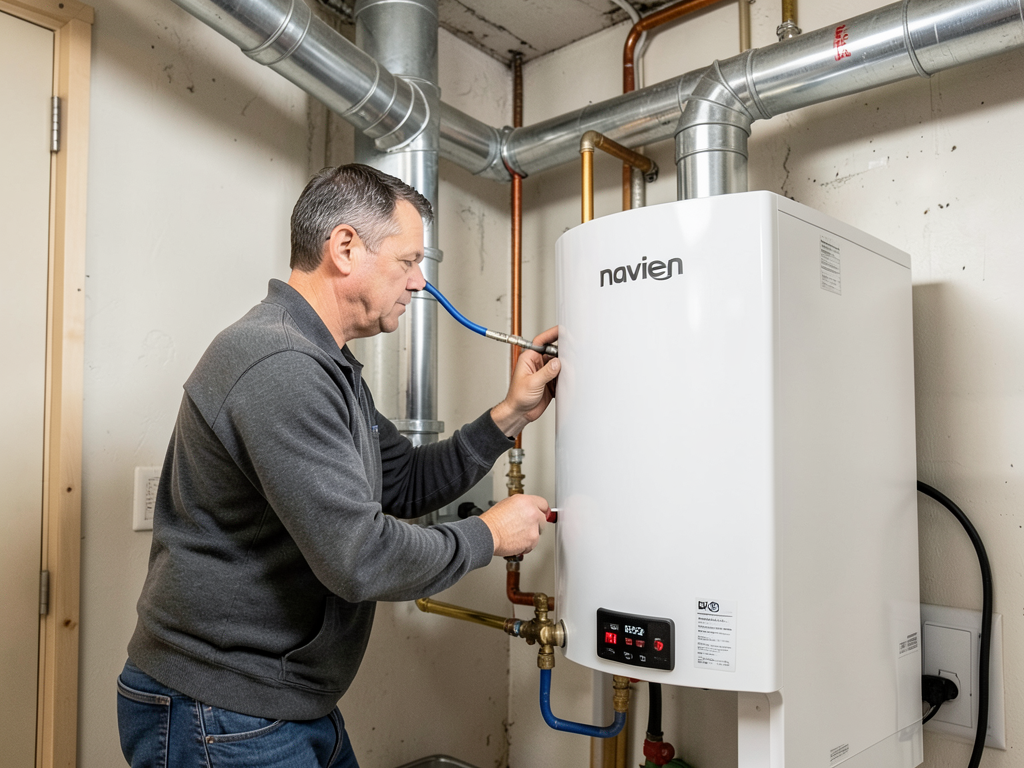
Comparing Navien and Rinnai Tankless Systems for Large Estates in Canton
Large estates in Canton require high-capacity tankless water heaters that can handle multiple bathrooms and luxury fixtures without dropping water temperature. The two leading brands for high-end installations are Navien and Rinnai, both offering condensing models with stainless steel heat exchangers and smart controls. Navien’s NPE-A2 series features built-in recirculation and a buffer tank for instant hot water, while Rinnai’s SENSEI RX series offers modular expansion and proven durability in Georgia’s climate. Your choice depends on your home’s simultaneous hot water demand, gas line capacity, and local code requirements. Navien official site.
Key Differences Between Navien and Rinnai Tankless Systems
Navien and Rinnai tankless systems differ in several technical areas that affect performance in large Canton estates. The most significant differences involve heat exchanger materials, recirculation technology, and smart home integration capabilities. Rinnai official site.
Navien uses a primary stainless steel condensing heat exchanger paired with a secondary flat plate heat exchanger in their NPE-A2 series. This design achieves up to 0.96 Uniform Energy Factor and includes a built-in buffer tank that eliminates cold water sandwich effects. The system also features ComfortFlow technology that maintains consistent temperature during high-demand periods.. Read more about Is a Heat Pump Water Heater the Right Choice for Your Energy Efficient Decatur Home?.
Rinnai’s SENSEI RX series uses a single high-efficiency stainless steel heat exchanger with their patented Circ-Logic recirculation system. While slightly less efficient at 0.93 UEF, the RX series offers modular expansion capabilities, allowing you to add units as your estate’s needs grow. The system integrates with most smart home platforms and provides detailed usage analytics through the Rinnai app.
Both brands meet Atlanta Gas Light requirements for high-altitude installations and comply with Georgia’s strict low-NOx emissions standards. However, Navien’s built-in recirculation pump typically requires less external plumbing work during installation, while Rinnai’s modular design allows for easier future upgrades without replacing the entire system. Plumbing Decatur.
Performance Comparison for Large Atlanta Homes
Large estates in Canton typically require 200,000 to 300,000 BTU systems to support multiple simultaneous showers, luxury tubs, and high-flow fixtures. The following comparison shows how each brand performs under Atlanta’s specific conditions.
| Model | BTU Rating | GPM @ 45°F Rise | UEF Rating | Recirculation |
|---|---|---|---|---|
| Navien NPE-240A2 | 199,900 | 11.2 | 0.96 | Built-in |
| Rinnai RU199iN | 199,000 | 11.0 | 0.93 | Optional |
| Navien NPE-240A2 | 199,900 | 11.2 | 0.96 | Built-in |
| Rinnai RU199iN | 199,000 | 11.0 | 0.93 | Optional |
Atlanta’s average groundwater temperature of 55°F means both systems need to provide approximately 45°F temperature rise for comfortable showers. At this rise, the Navien NPE-240A2 can supply 11.2 gallons per minute, enough for three simultaneous showers. The Rinnai RU199iN provides slightly less flow at 11.0 GPM but offers better turndown ratios for energy savings during low-demand periods.
For estates exceeding 4,000 square feet, you may need multiple units. Navien’s NPE series allows cascading up to 16 units, while Rinnai’s modular RX series can be expanded in 50,000 BTU increments. The choice often comes down to whether you prefer Navien’s integrated recirculation or Rinnai’s expansion flexibility.
Installation Requirements and Local Code Compliance
Installing tankless water heaters in Canton requires compliance with both Georgia State Minimum Standard Plumbing Code and local Cherokee County regulations. Both Navien and Rinnai systems must meet specific venting requirements and earthquake strapping standards. Getting Your Tankless Water Heater Fixed Fast in Sandy Springs.
Georgia code requires Category III stainless steel venting for all condensing tankless units. This means using AL29-4C stainless steel vent pipe with sealed joints and proper termination clearances. Both brands provide approved venting kits, but Navien’s integrated design often simplifies the installation process by reducing the number of required connections.
Gas line sizing is critical for large estates. A 199,000 BTU unit requires a minimum 3/4-inch gas line with proper pressure regulation. If your home has multiple high-BTU appliances, you may need to upgrade your gas meter or install a dedicated line. Rinnai’s RX series offers better gas modulation control, which can be beneficial if your gas supply fluctuates during peak usage times.
Local Cherokee County requires seismic strapping for all water heaters, including tankless models. Both brands provide approved strapping kits, but the installation method differs. Navien’s compact design makes wall mounting easier in tight mechanical rooms, while Rinnai’s modular approach allows for floor mounting with proper support structures.
Cost Analysis and Long-Term Value
Initial installation costs for high-capacity tankless systems in Canton range from $4,500 to $8,000, depending on complexity and required upgrades. Navien systems typically cost $500 to $700 more upfront but include built-in recirculation, which can save $300 to $500 in additional plumbing costs. Plumbing Roswell.
Annual operating costs depend on your water usage patterns and local gas rates. With Atlanta’s average gas price of $1.15 per therm, a 199,000 BTU unit operating at 80% capacity costs approximately $1.20 per hour. Both brands achieve similar efficiency, but Navien’s higher UEF rating can save $50 to $75 annually on utility bills.
Warranty coverage is another cost consideration. Navien offers a 15-year heat exchanger warranty, 5-year parts warranty, and 1-year labor warranty. Rinnai provides a 12-year heat exchanger warranty, 5-year parts warranty, and 1-year labor warranty. Both brands require professional installation and annual maintenance to maintain warranty coverage.. Read more about Plumbing Maintenance Checklist for Frequent Travelers Living in Alpharetta.
Long-term maintenance costs are similar for both brands. Annual descaling is recommended in Atlanta’s hard water conditions, costing $150 to $250 per service. Navien’s integrated design may require slightly less maintenance since the recirculation system reduces mineral buildup in the heat exchanger.
Smart Features and Home Integration
Modern tankless systems offer Wi-Fi connectivity and smart home integration, but the implementation differs between brands. Navien’s Control-R 2.0 app provides basic monitoring and scheduling capabilities, while Rinnai’s ThermaTouch interface offers more advanced features including voice control integration.
Navien systems integrate with Amazon Alexa and Google Assistant for basic voice commands like temperature adjustment and vacation mode activation. The app provides real-time monitoring of system performance, error codes, and maintenance reminders. However, the interface is somewhat basic compared to newer smart home platforms.
Rinnai’s SENSEI series offers superior smart home integration through their partnership with Nest and other major platforms. The system can automatically adjust water temperature based on occupancy sensors, weather forecasts, and time-of-use utility rates. The ThermaTouch interface provides a touchscreen control panel that can be mounted anywhere in your home.
For large estates with sophisticated home automation systems, Rinnai’s open API and broader third-party integration may be worth the additional cost. However, Navien’s simpler approach works well for homeowners who want basic smart features without complex programming requirements.
Local Parts Availability and Service Support
Parts availability is crucial for minimizing downtime when your tankless system requires repairs. Both Navien and Rinnai have established distribution networks in Atlanta, but the local support infrastructure differs significantly.
Navien has a distribution center in Norcross, Georgia, ensuring same-day or next-day parts delivery for most common components. Local plumbing supply houses like Ferguson and HD Supply stock Navien heat exchangers, control boards, and venting components. The brand’s growing popularity in Atlanta means most licensed plumbers are familiar with their systems. Plumbing Kennesaw.
Rinnai maintains a larger national distribution network with better parts availability for older models. Their long history in the US market means more local technicians have experience with their systems. However, the nearest major distribution center is in Charlotte, North Carolina, which can add a day to parts delivery times.
For large estates, consider the availability of high-capacity components. Navien’s NPE-A2 series uses proprietary parts that must be ordered through authorized distributors. Rinnai’s SENSEI series uses more standardized components that can sometimes be sourced from multiple suppliers, potentially reducing repair times.
Making the Right Choice for Your Canton Estate
The best tankless system for your Canton estate depends on your specific needs and priorities. Consider these factors when making your decision.
If you value instant hot water and want to minimize installation costs, Navien’s built-in recirculation system provides the best value. The integrated buffer tank eliminates cold water sandwich effects, and the higher efficiency rating reduces long-term operating costs. This makes Navien ideal for estates where immediate hot water at multiple fixtures is a priority.
If you prefer expansion flexibility and superior smart home integration, Rinnai’s modular design offers better long-term adaptability. The ability to add units as your needs grow without replacing the entire system provides better lifecycle value. Rinnai also excels in homes with sophisticated automation systems that require detailed usage analytics and voice control integration.
Consider your home’s specific layout and usage patterns. Estates with long plumbing runs benefit from Navien’s built-in recirculation, while those with multiple isolated hot water zones may prefer Rinnai’s modular approach. Both brands perform well in Atlanta’s climate, but Navien’s higher efficiency may provide better returns in homes with high hot water usage.
Professional installation is critical for both systems. A licensed plumber familiar with local codes and your home’s specific requirements can ensure optimal performance and warranty compliance. Before making your final decision, have a qualified technician assess your gas supply, venting requirements, and hot water demand to recommend the appropriate system size and configuration.
Frequently Asked Questions
What size tankless water heater do I need for a 5,000 square foot home?
A 5,000 square foot home typically requires a 199,000 to 250,000 BTU tankless system, or multiple smaller units. The exact size depends on the number of bathrooms, simultaneous usage patterns, and fixture flow rates. A professional load calculation ensures proper sizing.
How long do Navien and Rinnai tankless systems last?
With proper maintenance, both Navien and Rinnai tankless systems typically last 15 to 20 years. The stainless steel heat exchangers are the most durable component, while electronic controls and sensors may need replacement every 8 to 10 years. Annual descaling extends system life in Atlanta’s hard water conditions.
Can I install a tankless water heater myself?
Professional installation is required for both Navien and Rinnai tankless systems to maintain warranty coverage and ensure code compliance. These units require proper gas line sizing, Category III venting, and electrical connections that must meet local building codes. Improper installation can create safety hazards and void warranties.
What maintenance do tankless water heaters require?
Annual maintenance includes descaling to remove mineral buildup, checking venting for obstructions, testing safety controls, and cleaning the air intake filter. In Atlanta’s hard water conditions, descaling may be needed every 6 to 12 months. Professional maintenance costs $150 to $300 and ensures optimal performance and warranty compliance.
Do tankless water heaters work during power outages?
Standard tankless water heaters require electricity for controls, ignition, and safety systems, so they won’t work during power outages. However, both Navien and Rinnai offer battery backup options that can provide limited hot water for 24 to 48 hours. Some homeowners install whole-house generators for complete backup protection.
How much can I save with a tankless water heater?
Energy savings with tankless water heaters typically range from 24% to 34% for homes using less than 41 gallons of hot water daily. For larger estates with higher usage, savings may be 8% to 14%. Atlanta’s gas rates and your specific usage patterns determine actual savings, which can range from $50 to $150 annually.
Call (770) 610-5522 today to schedule your tankless water heater consultation and get a customized quote for your Canton estate. Our licensed plumbers will assess your home’s specific needs and recommend the best system for your budget and lifestyle.